
Type of diploma : DU University diploma
Length of studies : Possibility of completing the DU in 1 or 2 years
(student's choice)
Pattern: 120 hours of distance learning (asynchronous) 120 hours of fieldwork (face-to-face)
Target audience: students in their 2nd year of study or above
Number of credits: 24 ECTS
Fees : free for students enrolled in initial training at amU


-
Objectives
Optimize your project management skills and professionalize your commitment.
The course aims to provide you with a theoretical and practical knowledge base on corporate social responsibility (CSR), sustainable development objectives, project management, communications strategy, fund-raising and team management to meet the current needs of associations, local authorities, companies with a mission, non-governmental organizations (NGOs)...and support them in their commitment. -
Training specifics
The aim of this university diploma is to bring students face to face with the realities of the field, by enabling them to carry out 120 hours of commitment assignments in one or more organizations, combined with 120 hours of distance learning theory courses:
- Imagining the stakes of commitment (30h)
- Designing an engagement project (30h)
- Promoting an engagement project (30h)
- Managing an engagement project (30h)
Commitment is defined as: an individual or collective initiative carried out within an organization (association, company, local authority, school, university, ministry) that has a positive societal impact and benefits from academic support.
The aim is to respond to local needs in a variety of areas: sport, culture, humanitarian aid, health, social action, defending rights, education, the environment, solidarity, living well together, etc., and to connect local players with students. -
Why take this course?
For 4 main reasons:
1/ Enhance your "hard skills" in strategy, communication, finance, HR and project management, with a diploma and recognized field experience.
2/ Enhance the "soft skills" of autonomy, adaptability, perspective-taking, critical thinking and reflection, through the development of cross-disciplinary competencies.
3/ Enable initially inexperienced students toenhance their CVs to find future employment and build a professional project.
4/ Enable committed students to valorize their experience through "validation of prior learning", with an exemption from certain training modules *.
* Recognized commitment activities: volunteer work, associative commitment, civic service, military or police operational reserve, volunteer fireman, student employment, volunteer work, top-level sportsman...What's in it for you?
- By getting involved, students feel useful, develop their citizenship, meet new people, improve their self-confidence and well-being, discover their hidden talents, acquire professional skills and learn through service.
- Their experience is rewarded with a recognized university diploma.
-
Knowledge and skills to acquire
At the end of their training, future professionals will have acquired solid skills enabling them to :
- Develop personal and critical reflection on their involvement in volunteer work or associations.
- Be aware of the rights and duties of people involved in voluntary or professional activities, so as to be better integrated into a civic dynamic.
- Identify the 17 objectives of sustainable development and understand how to establish links between the essential components of a project (life cycle, players, objectives).
- Carry out a strategic diagnosis to identify needs and constraints.
- Use the social business model canvas to formalize and present their project.
- Structure a project taking into account technical, time and financial aspects, using appropriate tools.
- Develop a strategic communication vision adapted to different audiences.
- Master the steps involved in creating, executing and evaluating a communications campaign.
- Manage a societal project using indicators and a monitoring dashboard, while respecting legal obligations and quality of working life (QWL).
- Master the rights and duties of an association (legal, administrative, accounting, financial).
- Develop leadership skills and establish a managerial operating framework (conflict management, communication).- Imagine the challenges of commitment (30h)
- Designing a commitment project (30h)
- Promoting a commitment action (30h)
- Managing an engagement project (30h)
-
Career opportunities
At the end of the course, students will have acquired cross-disciplinary skills in project management and social responsibility. They will be able to aim for the following professions and/or further studies:
- Project manager for associations and NGOs
- from a bachelor's degree: further study in a master's degree, for example: Action Solidarité et Communication, Master Economie Sociale et solidaire or any other training related to social commitment project management within other establishments.
- Project manager for associations and NGOs
-
Admission
Recruitment period
2 recruitment sessions: April 22 to May 15 and September 8 to October 23, 2025
Who should apply?
Students in their 2nd year of study. Possibility of VAE.
Recommended prerequisites?
- Interest in themes related
student involvement.
- Understanding of the fundamentals of communications and institutional
responsibility (CSR)
- Interest in project managementApply at
-
Practical info
Start of courses
From 14/11/25.
Students take courses when they wish from the beginning of the school year. The 120h courses are distance learning on the Ametice platform.
Imagining the stakes of commitment (30h) - Designing a commitment project (30h) - Promoting a commitment action (30h) - Managing a commitment project (30h)Field assignment
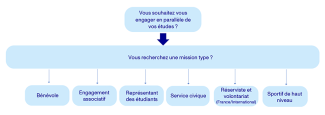
- Students can find their field assignment on their own
- or search the Ametice mission tab for a mission that the commitment unit has identified with local players.
- They can also visit the career center jobteaser (in partnership with jeveuxaider.gouv.fr) to integrate volunteer offers,
- or contact the BVE to join 1 student association...
Assessment methods
Continuous and final assessment in the form of learning and assessment situations (LES).
Registration fees
Free for students enrolled in initial training at amU. For external students, or those registering for the first time outside amU, the cost is 1,200 euros.
CONTACTS
Education Manager
Further information: engagement-etudiant@univ.amu.fr
